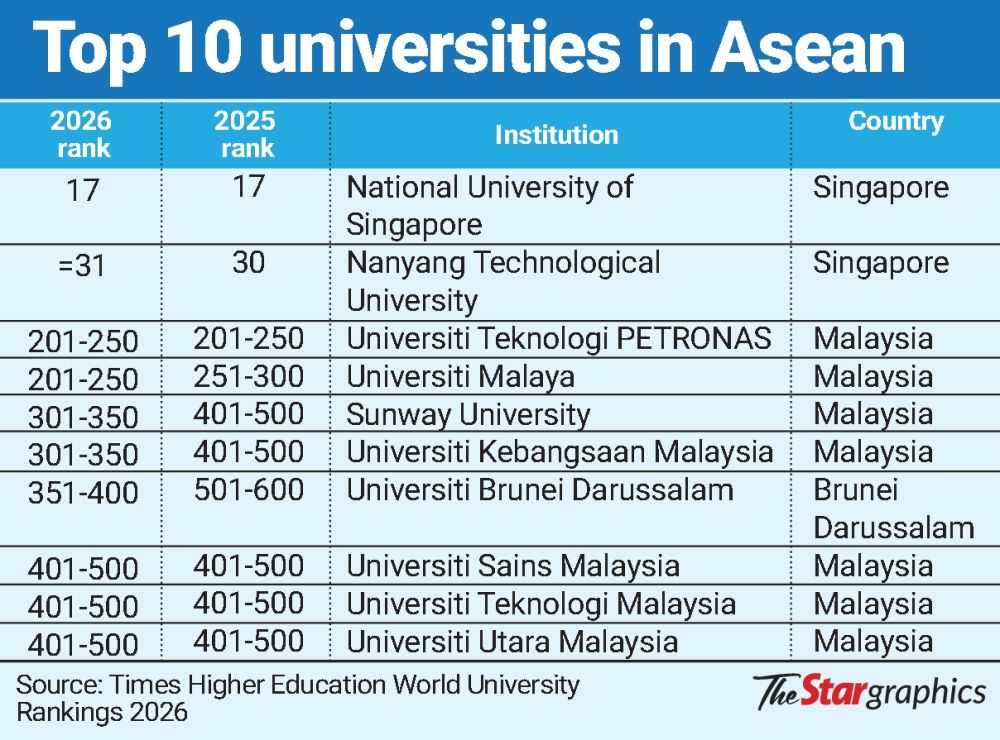


For many universities, international rankings such as QS and Times Higher Education have become the academic equivalent of the Olympic medal table. They promise visibility, prestige, and a global reputation. In Malaysia, rankings have influenced policies, leadership targets, and even funding decisions. Yet, in our obsession with the numbers, we risk losing sight of what truly defines a great university – the ability to transform lives, nurture thinkers, and create knowledge that matters.
The Mirage of Rankings
There is no denying that rankings serve a purpose. They allow institutions to benchmark themselves against global peers, identify gaps, and attract international students. But they also come with significant blind spots.
Most global rankings rely heavily on factors like citation counts, faculty-student ratios, and internationalisation metrics. These are convenient indicators, but they do not capture the full complexity of what makes a university impactful – its teaching quality, its service to society, or its contribution to local innovation and entrepreneurship.
For developing countries like Malaysia, where universities operate within different social and economic realities, such global yardsticks can be misleading. A university in Kelantan, for instance, may not have the same research budget or infrastructure as one in London or Singapore. Yet, its impact on local communities, SMEs, and regional development can be far more profound.
The Cost of Chasing Ranks
The pursuit of rankings often drives behaviour that looks impressive on paper but hollow in substance. Universities begin to focus on short-term metrics rather than long-term mission. Academic promotion and institutional recognition become tied to indexed publications rather than real impact.
The result is what some call “the publication trap,” producing research that adds to citation counts but not necessarily to knowledge that solves real problems. In the process, we neglect what universities were originally meant to do: educate, inspire, and empower.
Moreover, the ranking race can distort resource allocation. Instead of investing in teaching quality, community engagement, or translational research, funds are channelled into cosmetic international collaborations and citation-driven projects that serve the ranking algorithm more than the nation.
Learning from the Bold and the Brave
Interestingly, some of the world’s most respected universities are starting to question the value of rankings. Utrecht University and the University of Zurich have both stopped providing data to Times Higher Education, arguing that such systems oversimplify complex academic missions. Sorbonne University in France has followed suit, choosing to focus on Open Science and societal impact rather than competing for position on a league table.
In Asia, several Korean universities and leading Chinese institutions like Renmin and Nanjing University have similarly withdrawn from major rankings, advocating for more context-sensitive evaluation systems. These universities continue to attract top scholars and students – proof that genuine academic reputation is built on values, not numbers.
A Call for Purposeful Academia
Last week, I had a wonderful podcast session with Tan Sri Idris Jusoh, the former Minister of Higher Education. He started by sharing a quote from the Quran that the function of mankind is to be useful, a simple reminder that hit me hard. He also challenged academicians to change from teaching what they know, something AI can already do better, to learning with their students about what the future will be like. It was a profound insight: universities should not be the guardians of past knowledge but the co-creators of future possibilities.
Tan Sri Idris also remarked that while universities have succeeded in producing professionals, it is time to raise the bar by nurturing innovators. This, to me, captures the spirit of what Malaysian universities must become – not factories of credentials, but laboratories of creativity and purpose.
The UMK Example: Purpose Over Position
Universiti Malaysia Kelantan (UMK) offers a compelling example of how a university can build distinction without depending on rankings. Established with a clear mandate to drive entrepreneurship and innovation, UMK’s mission has always been rooted in national relevance – to nurture graduate entrepreneurs and uplift local entrepreneurs to compete globally.
Rather than competing in citation races, UMK can strengthen its standing by deepening its impact within this mandate. Its goal should not be to mimic large research-intensive universities, but to excel as Malaysia’s most entrepreneurial and innovation-driven university – one that measures success by the number of graduates who become job creators, not just job seekers.
Beyond producing professionals, UMK has the potential to nurture innovators, those who can identify problems, create solutions, and build enterprises that matter. This is the missing link in many higher education systems: nurturing innovation mindsets alongside technical and business knowledge.
With its established ecosystem, including the Ignite Venture Innovation Lab, strong ties with SMEs, and collaborations with local agencies, UMK is well-positioned to lead the national effort in developing the next generation of innovators. By focusing on this unique value proposition, UMK can continue to be a respected entrepreneurship university, recognised not for its rank, but for its results and relevance.
Rethinking Success in the Malaysian Context
Malaysian universities can, and must, chart their own path. Instead of chasing ranks, they can focus on relevance, resilience, and reputation – three dimensions that matter more in the long run.
· Relevance means aligning teaching, research, and innovation with national needs – digital transformation, green economy, social inclusion, and entrepreneurship. When universities solve real problems, their reputation follows naturally.
· Resilience means building strong internal ecosystems that encourage interdisciplinary collaboration, open science, and lifelong learning – not just publication output.
· Reputation should come from trust and impact, not ranking positions. Universities gain credibility when their graduates succeed, their research shapes policy, and their innovations reach communities and industries.
A Call for a New Evaluation Culture
Malaysia should move toward a broader performance framework that values societal impact, translational research, and innovation outcomes. The Ministry of Higher Education has begun exploring new rating mechanisms, such as MyRA’s community engagement and innovation indicators, but the emphasis must shift from compliance to creativity.
Universities should publish Impact Reports that highlight how their work improves lives, supports industries, and drives sustainable development. Employers, industry partners, and communities should become part of the feedback loop in assessing university performance. This would reflect the true essence of higher education – not as a competition, but as a contribution.
Conclusion: Rediscovering Purpose
Rankings are not inherently bad, but they should never define who we are or what we aspire to be. A university’s worth cannot be captured by a number. It is seen in the curiosity of its students, the courage of its researchers, and the compassion of its leaders.
If Malaysia’s universities, like UMK, can reconnect with that deeper purpose to educate minds, uplift communities, and innovate for the nation, they will not only thrive without the rankings, they will redefine what quality in higher education truly means.
Prof. Azizi is a senior academic at Malaysian Graduate School of Entrepreneurship and Business (MGSEB), UMK (https://mgseb.umk.edu.my) and former university leader with experience in research policy, academic governance, and innovation strategy. He currently teaches and consults on higher education and entrepreneurship and can be contacted at [email protected].