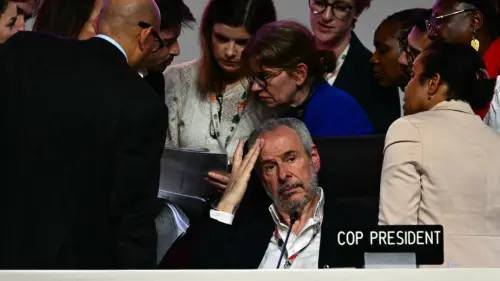


On a December night in Paris in 2015, the impossible happened: Nearly 200 countries agreed to try to limit global temperature rise to below 1.5 degrees Celsius, to avoid the worst impacts of climate change. Unfortunately, that target — a key part of the Paris Agreement struck at the 2015 United Nations Climate Change Conference (COP21) — has since proven to be almost certainly impossible to achieve.
Scientists now mostly agree that keeping global warming below 1.5 degrees Celsius is out of reach. A 2024 U.N. report found that if governments continue with their current emissions policies, the world is on course for a rise of up to 3.1 degrees Celsius this century. But not everyone is willing to give up on the target. In the 10 years since the Paris Agreement was adopted, the 1.5-degree limit has been the Schrödinger’s cat of climate policy: both dead and alive; simultaneously unachievable and still the axis upon which global climate negotiations spin.
More, here.